

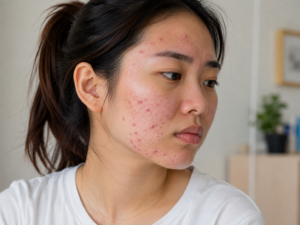
Skin purging happens when some skincare ingredients stimulate skin cell turnover. You may suffer from excessive breakouts, redness, and dryness which are common symptoms of skin purging before making skin improved. Fortunately, there are various ways to deal with skin purging.

Skin purging is a short-term skin response to specific components that can result in breakouts, skin dryness, flaking, and peeling. It usually happens when you attempt a new skincare product or several cosmetic treatments – most commonly retinol or exfoliating acids – and results in breakouts, dryness, flaking, or peeling before your skin’s condition ultimately improves.
Skin purging is characterized by small red pimples on the skin that are uncomfortable to touch. They are frequently associated with whiteheads or blackheads. It might also cause flakiness in your skin. Purging-induced flare-ups have a shorter lifetime than breakouts. It should recover considerably more quickly. These bumps are also more likely to emerge on parts of your face where you have regular breakouts. So, if you’re experiencing irritation in new regions, it’s most likely not due to purging. Each person has different skin, therefore, purging may appear in a variety of ways.

As a general guide, purging tends to begin within a few days to two weeks of starting a new active ingredient, often peaks around the three-to-four-week mark, and typically resolves within four to six weeks as your skin adjusts. This can vary depending on the specific ingredient, concentration, and your individual skin.
If your skin does not return to normal after a few weeks of treatment, or even if it worsens, you should visit a dermatologist to determine which product is safe to use. If you are suffering from cystic acne, scarring, or any serious skin condition, get quick medical attention.
Active ingredients to accelerate cellular turnover are typically found in anti-aging and exfoliating products since they are supposed to bring fresh, healthy skin cells to the surface and leave behind a more youthful, smooth complexion. These components can lead to skin purging, nevertheless, not everyone experiences purging when incorporating active chemicals in the routine because each has different skin. Below are ingredients that may cause skin purging
The most prevalent component that causes skin purging is retinol – a vitamin A derivative. Because of its capacity to stimulate collagen formation, retinol has become the standard therapy for premature skin aging.
If the purging process occurs, you should use a softer version of retinol to accelerate skin recovery.
Two chemical exfoliants used in skincare include Alpha and beta hydroxy acids. AHAs function on the skin’s surface, while BHAs penetrate deep into the pores. As a result, you’ll find more AHAs (such as glycolic acid) in brightening toners and face peels and BHAs (such as salicylic acid) in acne-fighting treatments. Both are active substances that might promote an increase in cellular turnover in situations where purging is possible.
When people use BHAs to cure acne, they may have the potential to produce even more acne. Allow these acne-fighting chemicals a few weeks to clean out the deep, beneath-the-surface gunk, and your skin should look considerably clearer.
This brightening antioxidant is an active component with moderate exfoliating capabilities that promote cellular turnover. Although vitamin C is less prevalent, some people may suffer a purge on their journey to glowing skin.
It’s critical to avoid making direct touch with your face. Touching your face increases your chances of growing bacteria, and interfering with the purging process might aggravate or prolong the flare-up.
It’s recommended to keep your skincare routine to a minimum during skin purging. Aside from the new product that you’re testing, stick to the skin-friendly products you’ve used before. Concentrate on your fundamentals, such as cleanser, toner, moisturizer, and SPF. You need to allow your skin time to adjust to this new ingredient.
It is important to wash your skin every morning and night to remove any debris, pollutants, residual makeup, and skincare residue that might clog your pores when getting skin purging. You should choose a mild, hydrating cleanser. Furthermore, remember to cleanse with lukewarm water; hot water can rob your skin of moisture and dry it out.
Strong physical exfoliation containing natural grains such as nutshells and fruit pits can produce dangerous micro-tears on the skin’s surface and exacerbate your acne. However, you should not completely forgo exfoliating; exfoliate at least once or twice a week with a gentle chemical exfoliator. This will help deeply cleanse and unclog your pores, buff away dead skin cells, then result in preventing acne and blackheads.
When you cleanse or use new items, you may disturb the equilibrium of your natural pH levels which fluctuates between 4.5 and 5.5. This implies that your skin’s health is at risk of infection caused by germs.
Using a toner before applying additional products can help to adjust PH levels and keep your skin barrier robust and healthy in order to battle bacteria. This will also assist to prepare your skin so that the elements in the remainder of your treatment may absorb more effectively.
Prolonged sun exposure might worsen purging. SPF is always necessary, especially while your skin is purging. Choose a lightweight sunscreen with at least SPF30 and reapply it every two hours. This will protect your natural skin barrier from free radicals and UV damage. It will also prevent you from environmental irritants that may irritate your delicate skin.
You can provide calming products to your skin in order to treat purging:
Introducing new active ingredients gradually is the most effective way to minimise a harsh purge:

Most purging resolves on its own with time and a consistent routine. It’s worth seeing a dermatologist if:
A dermatologist can help determine whether it’s genuine purging, an intolerance to a specific ingredient, or an unrelated skin condition, and adjust your routine accordingly.
A temporary skin reaction to actives like retinol or exfoliating acids that speed up cell turnover, bringing existing congestion to the surface faster, before the skin ultimately improves.
Purging usually appears in your typical breakout-prone areas as small, uniform bumps, and improves over several weeks. A breakout can appear in new areas, look more inflamed, and persists without a change in routine.
Typically 4–6 weeks total, often peaking around week 3–4, though this varies by ingredient and individual skin.
Yes, it can – as it clears congestion from within pores, some people experience a temporary increase in breakouts during the first few weeks.
It’s possible, though generally somewhat less common than with salicylic acid or retinol, since it works more on the skin’s surface.
Skin purging is a normal, temporary response to actives like retinol, AHAs, and BHAs – but knowing how to tell it apart from a genuine breakout, and how long to reasonably expect it to last, makes it much easier to know when to push through and when to stop. Keeping your routine simple, supporting your skin barrier, and introducing new actives gradually can make the process more comfortable. If your skin isn’t improving after several weeks, or something feels off, it’s worth getting it properly assessed rather than guessing. You can consult a doctor through the MaNaDr app if you’d like a professional opinion on whether what you’re experiencing is purging or something that needs a different approach.