What Is Narcolepsy? Signs, Diagnosis & Therapy: Could You Be Affected Without Knowing? - Manadr
What Is Narcolepsy? Signs, Diagnosis & Therapy: Could You Be Affected Without Knowing?
MaNaDr2022-05-10
Narcolepsy is a chronic neurological condition that significantly affects the brain’s ability to control sleep-wake cycles. Far more than just feeling tired, individuals with narcolepsy sleep disorder experience overwhelming daytime sleepiness and sudden, irresistible urges to sleep, often at inappropriate times. This can profoundly impact daily life, safety, and social functioning.
Understanding what is narcolepsy, its complex narcolepsy symptoms, underlying causes, precise diagnosis, and effective treatment and therapies is crucial for those living with this challenging condition. This comprehensive guide aims to shed light on this often-misunderstood disease narcolepsy, helping you recognize its subtle signs and learn how to manage it for an improved quality of life.
1. What Exactly Is Narcolepsy?
To truly grasp the impact of this condition, it’s essential to understand its fundamental definition and the underlying neurological mechanisms. Often, individuals may have symptoms without realizing they indicate a specific medical condition.
1.1. Narcolepsy Definition and Meaning
Narcolepsy is a chronic neurological sleep disorder that impairs the brain’s ability to regulate sleep-wake cycles. It is fundamentally a problem with the brain staying awake and controlling sleep. For those asking, “what is narcolepsy” or seeking a concise “narcolepsy definition,” it’s a condition where the boundaries between wakefulness, non-rapid eye movement (NREM) sleep, and rapid eye movement (REM) sleep become blurred, leading to intrusive sleep phenomena.
Essentially, “what does narcolepsy mean” is that an individual experiences irresistible bouts of sleep, known as sleep attacks, that can occur at any time, often in surprising or inconvenient situations. This isn’t laziness or simply being very tired; it’s a genuine neurological impairment. The term “narcoleptic meaning” refers to a person affected by this disorder, experiencing its distinct features. It is a lifelong sleep disorder narcolepsy that requires ongoing management.
1.2. The Core Problem: Brain’s Sleep-Wake Control
At the heart of narcolepsy lies a dysfunction in the brain’s sleep-wake regulation. For Narcolepsy Type 1 (the most common form with cataplexy), the primary issue is a severe deficiency of a neurotransmitter called hypocretin (also known as orexin). Hypocretin neurons, located in the hypothalamus region of the brain, play a critical role in promoting wakefulness and regulating REM sleep.
In individuals with narcolepsy, these hypocretin-producing neurons are often damaged or lost. This deficiency leads to instability in the sleep-wake state, causing:
Intrusion of REM Sleep: Elements of REM sleep (like vivid dreaming, muscle paralysis, and loss of muscle tone) inappropriately enter wakefulness.
Sudden Sleep Attacks: The inability to resist falling asleep.
This fundamental breakdown in the brain’s ability to maintain stable wakefulness is what defines narcolepsy.
1.3. How Common is Narcolepsy? (Prevalence & Impact)
While not as widely recognized as insomnia, narcolepsy is a significant public health concern globally, profoundly affecting millions.
Prevalence: Globally, estimates for narcolepsy prevalence range from 0.02% to 0.18% of the population (National Institute of Neurological Disorders and Stroke – NINDS/NIH; American Academy of Sleep Medicine – AASM). This means hundreds of thousands, if not millions, of individuals worldwide are living with this condition.
Age of Onset: Symptoms typically begin between the ages of 10 and 25, though the condition can manifest earlier in childhood or later in adulthood. However, there’s a significant global delay in narcolepsy diagnosis, often extending for 8 to 15 years, due to lack of awareness or misdiagnosis (National Sleep Foundation).
Impact on Quality of Life: The impact of narcolepsy is profound and far-reaching. Individuals living with this sleep disorder narcolepsy face significant challenges:
Safety Risks: Sudden sleep attacks or falling asleep randomly can pose dangers, especially while driving or operating machinery.
Academic and Occupational Impairment: Difficulty staying awake and concentrating can severely affect school performance and career stability.
Social and Emotional Challenges: Misunderstanding from others, stigma, and the unpredictable nature of symptoms can lead to social isolation, anxiety, and depression.
Reduced Quality of Life: The constant battle against sleepiness significantly diminishes overall well-being and ability to engage fully in life.
2. What Are the Symptoms and Signs of Narcolepsy?
Understanding the distinctive narcolepsy symptoms is key to recognizing this often-missed condition. While excessive daytime sleepiness is the hallmark, other less common but equally important signs of narcolepsy complete the clinical picture. These narcolepsy symptoms in adults and children can vary in severity.
2.1. Cardinal Symptoms of Narcolepsy
The four primary symptoms, often referred to as the “tetrad,” although not all are present in every individual, include:
Excessive Daytime Sleepiness (EDS): This is the most prevalent and often the most debilitating symptom. It’s an overwhelming, chronic sense of drowsiness and an irresistible urge to sleep, regardless of the situation. Individuals may experience falling asleep randomly or falling asleep suddenly in routine activities like working, talking, or eating. This is “what is it called when you fall asleep randomly” or the “falling asleep disorder.” Despite having adequate nighttime sleep, they remain drowsy.
Cataplexy: This is a sudden, brief loss of muscle tone or strength while a person is awake. It’s often triggered by strong emotions, such as laughter, excitement, anger, surprise, or stress. During a narcolepsy cataplexy attack, the individual remains fully conscious but may experience slurred speech, weakness in the knees, a drooping jaw, or even complete body collapse. The severity can range from subtle facial weakness to a full body fall. Narcolepsy and cataplexy are strongly linked, especially in Type 1.
Sleep Paralysis: This involves a temporary inability to move or speak when falling asleep or upon waking up. Episodes can last from a few seconds to several minutes and can be frightening. The individual is fully conscious but feels paralyzed.
Hypnagogic Hallucinations: These are vivid, often frightening, dream-like experiences that occur when falling asleep (hypnagogic) or, less commonly, upon waking (hypnopompic). They can be visual, auditory, or tactile, and often accompany sleep paralysis, blurring the lines between dreaming and reality.
2.2. Other Common Symptoms
Beyond the cardinal symptoms, individuals with narcolepsy may experience other issues:
Fragmented Nighttime Sleep: Despite overwhelming daytime sleepiness, many individuals with narcolepsy have difficulty staying asleep through the night, experiencing frequent awakenings. This is often described as a “sleeping disorder narcolepsy” that affects both day and night.
Automatic Behavior: Performing routine tasks without conscious awareness or memory of doing so. This can happen during brief sleep attacks, where the person continues to talk or write but then has no recollection.
Memory Problems: Difficulty concentrating, paying attention, and remembering information due to chronic sleepiness.
Blurred Vision or Double Vision: These visual disturbances can occur during periods of increased sleepiness or during brief sleep attacks.
Weight Gain: Often due to changes in metabolism, diet, or decreased physical activity as a result of fatigue.
2.3. Expert Insight: Not Just the “Falling Asleep Disease”
Expert Insight: A common myth is that “narcolepsy only means suddenly falling asleep at any moment, like collapsing instantly, making it just a simple ‘falling asleep disease’.” While sudden sleep attacks are a key feature, sleep specialists clarify the crucial fact that the most constant and often most debilitating symptom is actually chronic, overwhelming daytime sleepiness. Furthermore, cataplexy (sudden muscle weakness triggered by emotions, where consciousness is maintained) is a unique and defining symptom of Narcolepsy Type 1 that is entirely distinct from just falling asleep. This broader understanding is vital for proper diagnosis and recognizing the full impact of being narcoleptic.
If you’re experiencing persistent, overwhelming sleepiness, sudden muscle weakness with emotion, or other concerning sleep issues, seeking an initial assessment is vital. MaNaDr offers a discreet way to consult with online doctors 24/7 to discuss your concerns and get guidance.
3. What Causes Narcolepsy and What Are Its Types?
Understanding the underlying narcolepsy causes is crucial for distinguishing its different forms and developing targeted treatment for narcolepsy. While the exact narcolepsy etiology is still being researched, significant progress has been made, particularly in understanding Narcolepsy Type 1.
3.1. What Causes Narcolepsy? Types of Narcolepsy
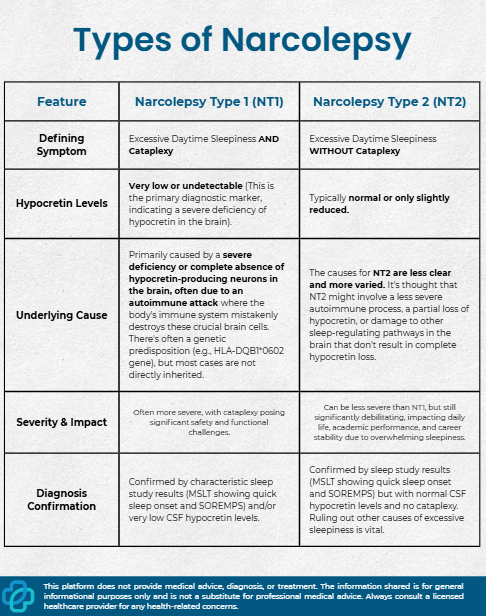
The two primary types of narcolepsy are classified based on the presence or absence of cataplexy, a sudden loss of muscle tone triggered by strong emotions. Understanding these distinctions is key to proper diagnosis and tailored treatment for narcolepsy.
3.2. Risk Factors and Triggers
While the exact cause is often an autoimmune process, certain factors can increase risk or trigger onset:
Genetics: A family history slightly increases risk (though most cases are sporadic). Specific genetic markers (like HLA-DQB1*0602) are linked to NT1, suggesting a genetic predisposition for the autoimmune attack.
Environmental Triggers: Certain environmental factors, particularly infections, are thought to trigger the autoimmune response in genetically predisposed individuals. The H1N1 influenza virus and vaccination (Pandemrix) were notably linked to increased cases of NT1 in some populations during the 2009 pandemic.
Brain Injury/Disorders: As mentioned, specific injuries or neurological conditions affecting the hypothalamus can rarely lead to secondary narcolepsy.
Age of Onset: While it can develop at any age, symptoms typically emerge in adolescence or young adulthood.
4. How Is Narcolepsy Diagnosed?
Receiving a definitive narcolepsy diagnosis can be a challenging and lengthy process. Individuals often experience symptoms for years, sometimes decades, before being accurately diagnosed. Understanding how is narcolepsy diagnosed is crucial for patients seeking answers and effective treatment for narcolepsy.
4.1. The Challenge of Diagnosis
The significant delay in diagnosing narcolepsy (averaging 8-15 years for some individuals) is common due to several factors:
Lack of Awareness: Many healthcare providers and the general public are not fully aware of all narcolepsy symptoms, especially cataplexy.
Misdiagnosis: Symptoms like excessive daytime sleepiness can be misattributed to other conditions such as depression, chronic fatigue syndrome, sleep apnea, or even simple insomnia or laziness. Cataplexy can sometimes be mistaken for seizures or fainting spells.
Subtle Symptoms: Some symptoms, particularly hypnagogic hallucinations or sleep paralysis, may not be reported by patients who don’t realize they’re part of a medical condition.
4.2. Diagnostic Tests
If you’re wondering “how to know if you have narcolepsy” or “do I have narcolepsy,” a comprehensive evaluation by a sleep specialist is necessary. The process to diagnose narcolepsy typically involves:
Detailed Medical History and Symptom Evaluation: The sleep specialist will conduct an in-depth interview about your sleep patterns, daytime sleepiness, any episodes of sudden muscle weakness (cataplexy narcolepsy), sleep paralysis, hallucinations, and any other relevant medical history. Keeping a detailed sleep diary for 1-2 weeks prior is often very helpful.
Polysomnogram (PSG) – Overnight Sleep Study: This is an overnight sleep test conducted in a sleep lab. It monitors various physiological parameters while you sleep, including brain waves (EEG), eye movements (EOG), muscle activity (EMG), heart rhythm (ECG), and breathing. The PSG helps rule out other potential causes of excessive daytime sleepiness, such as sleep apnea or restless legs syndrome, and can identify fragmented nighttime sleep common in narcolepsy.
Multiple Sleep Latency Test (MSLT) – Daytime Nap Study: This is the cornerstone of narcolepsy diagnosis. It’s conducted the day after the PSG. You’ll be given several opportunities (usually four or five, 2 hours apart) to nap in a quiet, dark room during the day. The MSLT measures two key things:
How quickly you fall asleep (sleep latency). Individuals with narcolepsy typically fall asleep very quickly (within 8 minutes on average).
Whether you enter REM sleep quickly (Sleep Onset REM Periods – SOREMPS). Individuals with narcolepsy often enter REM sleep rapidly (within 15 minutes) in at least two of the naps.
Cerebrospinal Fluid (CSF) Analysis (for Narcolepsy Type 1): In some cases, especially when the diagnosis is uncertain or to confirm Narcolepsy Type 1, a lumbar puncture may be performed to measure hypocretin-1 levels in the cerebrospinal fluid. Very low or absent hypocretin-1 levels are highly indicative of NT1. This helps “how do you know if you have narcolepsy Type 1.”
4.3. Expert Insight: Beyond Just Feeling Tired
Expert Insight: A common myth is that “if I just feel tired all the time, I probably have narcolepsy.” While excessive daytime sleepiness is the hallmark, sleep specialists clarify the crucial fact that narcolepsy is a complex neurological disorder defined by very specific diagnostic criteria based on comprehensive sleep studies (Polysomnogram and Multiple Sleep Latency Test) and sometimes hypocretin levels. Chronic fatigue and daytime sleepiness are common symptoms of many conditions, from poor sleep hygiene to depression or other medical issues. A thorough sleep evaluation by a board-certified sleep specialist is essential for accurate narcolepsy diagnosis and to differentiate it from other causes of sleepiness.
If you’re experiencing persistent, overwhelming sleepiness, sudden muscle weakness triggered by emotions, or other concerning sleep issues, and you’re wondering “how to tell if you have narcolepsy” or “how do you know if you have narcolepsy,” MaNaDr offers a convenient way to consult with online doctors 24/7. They can help discuss your symptoms and guide you toward the appropriate diagnostic steps with a sleep specialist.
5. What Treatments and Therapies Are Available for Narcolepsy?
While there is currently no cure for narcolepsy, effective narcolepsy treatments and management strategies can significantly alleviate narcolepsy symptoms and improve an individual’s quality of life. The goal of treatment for narcolepsy is to manage symptoms, improve alertness, reduce sleep attacks, and enhance overall well-being. For those asking “can narcolepsy be cured?”, the current medical consensus is that it is a lifelong condition requiring ongoing management.
5.1. Goals of Narcolepsy Treatment
The primary goals of narcolepsy therapy focus on symptom control and functional improvement:
Manage Excessive Daytime Sleepiness (EDS): To help individuals stay awake and alert during the day, reducing sleep attacks.
Control Cataplexy: To reduce the frequency and severity of cataplexy episodes, which are particularly disruptive and dangerous.
Improve Nighttime Sleep: To reduce fragmented sleep and promote more restful sleep at night.
Enhance Quality of Life: To enable individuals to safely participate in work, school, social activities, and daily life.
5.2. Medications for Narcolepsy
Various narcolepsy medications are available, tailored to individual symptoms and responses.
Stimulants: These medications are the primary narcolepsy treatment for EDS and sleep attacks. They help promote wakefulness.
Modafinil (Provigil) & Armodafinil (Nuvigil): Often first-line due to fewer side effects than traditional stimulants.
Methylphenidate (Ritalin) & Amphetamines (Adderall): More potent stimulants, often used when modafinil/armodafinil are insufficient.
Sodium Oxybate (Xyrem, Xywav): This unique medication is typically taken in two doses at night. It is highly effective for both cataplexy and excessive daytime sleepiness, and it can also improve fragmented nighttime sleep.
Antidepressants: Certain antidepressants (e.g., tricyclic antidepressants, selective serotonin reuptake inhibitors – SSRIs, serotonin-norepinephrine reuptake inhibitors – SNRIs) can be effective in suppressing REM sleep-related symptoms like cataplexy, sleep paralysis, and hypnagogic hallucinations.
Newer Medications: Recent advancements have introduced other options like pitolisant (Wakix) and solriamfetol (Sunosi) which work via different mechanisms to promote wakefulness.
5.3. Lifestyle Adjustments and Behavioral Strategies
Medication is most effective when combined with consistent lifestyle changes, forming a comprehensive narcolepsy therapy approach.
Scheduled Naps: Strategically planned, short naps (e.g., 15-20 minutes) throughout the day can significantly improve alertness and reduce the severity of involuntary sleep attacks.
Regular Sleep Schedule: Maintaining a consistent bedtime and wake time, even on weekends, helps regulate the body’s natural sleep-wake rhythm.
Good Sleep Hygiene: Creating a conducive sleep environment (dark, quiet, cool), avoiding electronics before bed, and having a relaxing bedtime routine.
Diet and Exercise: Eating a healthy, balanced diet and engaging in regular physical activity can improve overall energy levels and sleep quality. Avoid heavy meals before bed.
Avoiding Triggers: Limiting or avoiding alcohol, caffeine, and nicotine, especially close to bedtime, as they can disrupt nighttime sleep and worsen daytime sleepiness.
5.4. Expert Insight: Lifelong Management, Not Cure
Expert Insight: A common myth is that “once I’m on narcolepsy medication, my symptoms will completely disappear, and I can live exactly as before.” Sleep specialists emphasize the crucial fact that while medications significantly improve narcolepsy symptoms and quality of life for most individuals, they typically don’t eliminate the symptoms entirely. Narcolepsy is a chronic, lifelong condition, and effective management usually involves a combination of medication, careful lifestyle adjustments, and ongoing support. The goal is optimal symptom control and functional improvement, not a “cure,” which is not currently available.
If you are seeking advice on narcolepsy treatments, medication management, or strategies for living with narcolepsy, MaNaDr offers a discreet and convenient platform to connect with online doctors 24/7 for expert consultations and personalized guidance.
Conclusion
Narcolepsy is a chronic neurological sleep disorder that impacts millions, affecting the brain’s ability to control sleep and wakefulness. Understanding what is narcolepsy, its unique narcolepsy symptoms like excessive daytime sleepiness and cataplexy, and its complex causes is the first step toward managing this challenging condition. While there is currently no cure for narcolepsy, accurate diagnosis and a comprehensive narcolepsy treatment plan—combining medication with strategic lifestyle adjustments—can significantly improve an individual’s alertness, safety, and overall quality of life.
Don’t dismiss persistent sleepiness or sudden sleep attacks as mere fatigue. If you suspect you or a loved one might be affected by narcolepsy, early evaluation and ongoing management are vital. MaNaDr is here to empower you with immediate access to qualified medical professionals through our AI-powered teleconsultation platform, ensuring you can connect with the right specialist 24/7. Take control of your sleep health journey today.
Disclaimer: This article is for informational purposes only and does not constitute medical advice. Always consult with a qualified healthcare professional for diagnosis and treatment of any medical condition.