


For couples embarking on the journey of parenthood, achieving conception can be both a source of immense joy and a potential cause of stress. If pregnancy is not occurring as anticipated, a semen analysis becomes a crucial tool in the male fertility evaluation process.

A semen analysis – sperm test – is a laboratory test that comprehensively evaluates the physical characteristics and health of a man’s sperm. It’s a relatively straightforward procedure: a semen sample is collected and examined by trained laboratory professionals, who assess several key parameters covering sperm quantity, movement, shape, and the fluid itself. It’s one of the most commonly used tools in evaluating male fertility, and is often among the first tests recommended when a couple is having difficulty conceiving.
You may see this test referred to by several different names, all describing the same procedure:
Whichever name you come across, these all refer to the same laboratory evaluation of a semen sample.

A semen analysis is central to evaluating male fertility, and doctors may recommend it for several reasons:
The general process typically involves:

A semen analysis evaluates several parameters:
What Counts as a “Normal” Result?
The World Health Organization’s 6th edition manual (2021) provides widely used reference values, based on data from around 3,500 fertile men whose partners conceived naturally within a year. The lower reference limits include:
It’s important to understand what these numbers actually represent: they’re the 5th percentile of a fertile reference population – a statistical benchmark, not a strict pass/fail line. A single result below these values isn’t, on its own, a diagnosis of infertility; sperm parameters can vary between samples, and your doctor will typically recommend a repeat test before drawing any conclusions.
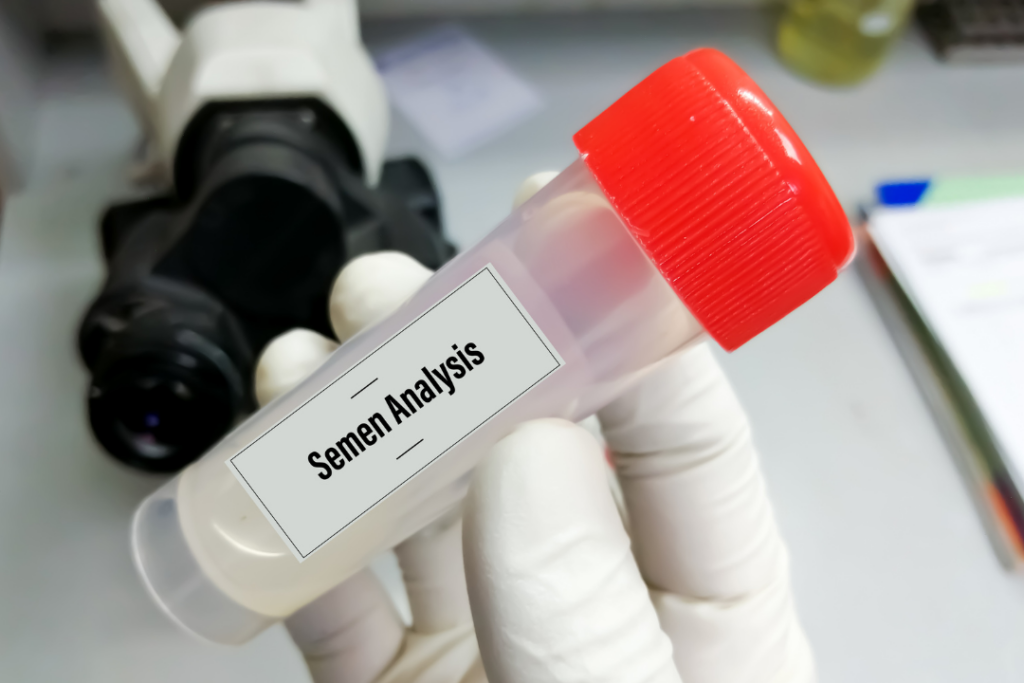
A qualified physician will interpret the results of your semen analysis. While there are no universally standardized “normal” ranges for all parameters, a healthy semen sample generally exhibits a high sperm count, good motility, normal morphology, and adequate volume.
An abnormal semen analysis result does not necessarily translate to absolute infertility. Underlying causes may be identified and addressed through appropriate treatment plans. Your doctor will guide you through the results, discuss potential causes, and recommend the most suitable course of action, which may involve further testing, medications, or lifestyle adjustments.
A laboratory test that evaluates sperm count, motility, morphology, and semen volume, most commonly used to assess male fertility.
Also known as a sperm count test, seminogram, sperm analysis, or male fertility test – all referring to the same procedure.
It’s often one of the first steps in evaluating male fertility when a couple has difficulty conceiving, and is also used post-vasectomy and to investigate certain other reproductive health concerns.
A sample is collected (at home or at a clinic), typically after a few days of abstinence, and analysed in a lab for sperm count, motility, morphology, and other parameters.
Per WHO 2021 reference values: sperm concentration of at least 16 million/mL, total motility of at least 42%, progressive motility of at least 30%, and at least 4% normal morphology — though these are statistical benchmarks, not strict pass/fail cutoffs.
A semen analysis is a straightforward, informative test that plays a central role in evaluating male fertility – measuring sperm count, motility, morphology, and semen volume against well-established reference values. An abnormal result isn’t the end of the story; it’s typically the start of a conversation with your doctor about next steps. If you have concerns about men’s health, connect with a doctor on the MaNaDr App for a private consultation.